Tuesday, June 23, 2015

i2b2 AUG Annual Meeting

Impressive opening session where we heard from a large set of users of i2b2 including (forgive me for selective memory and the Boston folks explicitly excluded):

  • at UNC/South Carolina and regionally
  • lots of work on biobanking
  • ACT network across CTSAs
  • Cancer Centers (e.g. the Kimmel Cancer Center)
  • University of Alabama (part of SHRINE) and Cimino
  • Deborah Batson from Colorado ensuring that good stuff is available to local researchers.
  • Microbiome data integrated with i2b2 in Germany. R Script.
  • October 9th- European i2b2 AUG meeting in Leicester, UK
  • TriNetX engaged in several productive contracts.
  • San Antonio (part of a PCORI) working on closing the gap between biostatistics and 
  • UC Davis, UCSF part of a large 
  • Autoimmune Foundation aligning multiple small groups.
  • Dan Baker at EPIC gave a lot of encouragement about collaboration and integration with i2b2
  • Adding statistical capabilities to the web client
  • Genomic full sequence integration with EHR
  • University of Florida (70+ papers published using i2b2)
  • Russ W. from Kansas spoke about a wide range of applications and Cerner integration.

Doug MacFadden gave an update on i2b2 SHRINE.

Nich demonstrated real-time 21-site (yes, twenty-one clinical sites) responding to queries. He also demonstrated vetting recruited patients through a new set of i2b2 plugins.

Ken talked about involving patients and recruiting patients with SMART apps.
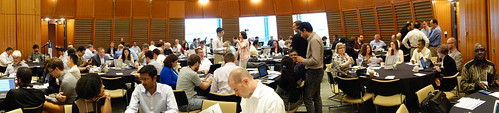
Getting ready for the meeting


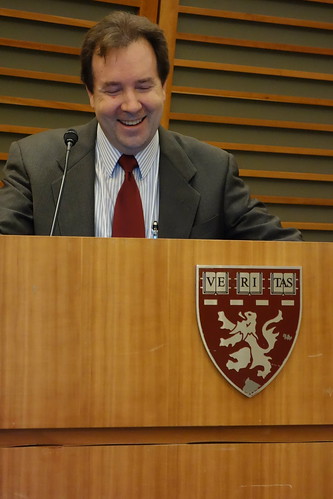
Shawn Murphy kicks off i2b2 AUG meeting

Monday, June 9, 2014

Cardiovascular Research Grid

I just learned of an interesting research effort and toolkit called the Cardiovascular Research Grid. It’s quite extensive in the data types it supports and includes i2b2 for integration with clinical data and the Globus toolkit for funneling genomic data to the Galaxy genomics analytic platform. Many other tools for imaging data and its analysis as well. Quite impressive.

Sunday, April 6, 2014

Success with Transmart at Pharma

Our i2b2 cousin-community, Transmart, is continuing to thrive: See http://ubm.io/1lEWEg9 

Saturday, February 1, 2014

i2b2 evaluation

John Bickel shared an interesting paper in which he and his colleagues investigated the use of i2b2 for cohort identification.

1/15/2014: All Hands Meeting:

Tim Miller, PhD (CS) from Guergana’s group presented his work on extracting and representing temporal relations from narrative text. And he focused on the “CONTAINS” relation which is useful in multiple ways which he illustrated across several use cases.

DBP: IBD

December 12th, 2013
Three projects reviewed:
  • Mortality and extra intestinal cancers in primary sclerosing cholangits (PSC) and inflammatory bowel disease.
  • Vitamin D and C. Diff infections
  • Thromboprophylaxis in IBD (post-hospitalization)

Friday, June 21, 2013

All Hands Meeting—Network Medicine

Dr. Ed Silverman, Professor of Medicine and Chief of the Channing Division of Network Medicine gave a broad and fascinating tour of respiratory physiology and the underlying population genetics.

UntitledUntitledUntitled

Friday, May 17, 2013

Profiles—A Tool to Study Researcher Communities

Griffin Weber described the Profiles open source tool that is now being used world wide that was first developed for our work in Harvard Catalyst. It is used to find collaborators, create teams for research projects, study promotion and the processes of academia.

Untitled

Death and its predictors

Professor Tianxi Cai ran a very interesting discussion about generating risk profiles for biomarkers and the problem in adjusting out the diseases that are along the causal pathway to mortality of those biomarkers. As a result of such an over adjustment, most biomarkers will give counter-conventional-wisdom associations.

Friday, May 10, 2013

Governance models for distributed queries across heterogeneous healthcare institutions

Murphy, Bickel, Kohane, Simons, Churchill, Mendis. Wattanasin, Weber, Donahoe, MacFadden

Discussed the interaction between different governance models and how they interact with the architecture.

Friday, April 5, 2013

Characterizing Coronary Artery Disease (CAD) in the EHR

Profs Cai and Shaw led a discussion of the the CAD NLP algorithm and demonstrated how the different priors and different ascertainment biases of different clinics could affect the accuracy of the NLP classification. Also discussed counter-intuitive coefficients in the model which may reflect confounding by the treatments for CAD.

rUntitled

NLP

Guergana's team: discussed speed issues.

cTAKES with full UMLS module takes about 150 notes/hour/core. Discussed various architectural tradeoffs.

Friday, March 15, 2013

All Hands Meeting Ps

10:14 AM, Mar 15, 2013

Jordan Smoller, co-PI of the MDD-SSRI-resistance i2b2 DBP presented today the paper he contributed to that made a lot of headlines regarding genomic variants shared across 5 psychiatric disorders.

Untitled

Accelerating NLP

Tianxi Cai led a discussion of "Semi Automated Model Building Using Knowledge Bases" using bibliographic external sources of medical knowledge to generate the candidate terms for a NLP filter to phenotype a particular characteristic.

Friday, February 1, 2013

Inflammation DBP

Tianxi Cai led a discussion of how to discretize (or not) some of the parameters across our various disease populations regarding inflammatory burden. Also determination of whether we use the study population to establish the reference range or use the larger "official" reference ranges. Szolovits quoted the wonderful paper: The haze of Bayes, the aerial palaces of decision analysis, and the computerized Ouija board.

i2b2 DBP

Friday, January 11, 2013

Epigenetic states and outcome

Professor Tianxi Cai led a discussion on the study designs to relate epigenetic endopathotypes and clinical outcomes.

Tianxi Cai discusses study designTianxi Cai discusses study designTianxi Cai discusses study designTianxi Cai discusses study designTianxi Cai discusses study designTianxi Cai discusses study design

Annotation of clinical notes

Guergana led a discussion of the user interface challenges of term selection (in an annotation of a clinical document task). She re-introduced the crew to the UMLS and Concept Unique Identifiers (CUIs). Understanding the dependencies, as Shawn Murphy pointed out is critical to providing users just the right set of terms to pick from (too many terms includes too many irrelevant terms and distracts/consumes the user and too few terms cripples expressivity). So we recognize that knowledge of the UMLS and the medical task is going to be required to optimally select the right set of CUI's to identify patients of interest. Sheng Yu demonstrated work in collaboration with Tianxi Cai that is quite striking in its ability to use the patient corpus to select (rank highly in a pick list) the CUI's of greatest relevance.

Friday, January 4, 2013

NLP games

Cai, Savova et al.

Discussed tradeoffs between performing string matching (hard to scale to the general case, but quite adequate accuracy for well specified and specific narrow cases) and general NLP. Also discussed how to enrich prior probability for a disease of interest to increase performance of high specificity NLP.