Shaw, Kohane, Kasif, Plenge, Churchill, Liao, Murphy, Savova
Extensive discussions about which epigenetics marks are best captured from clinical discards and under what hypotheses.
Shaw, Kohane, Kasif, Plenge, Churchill, Liao, Murphy, Savova
Extensive discussions about which epigenetics marks are best captured from clinical discards and under what hypotheses.
Murphy, Karlsson. Gainer, Shaw, Savova, Szolovits, Liao, Kohane, Churchill, Cai,
Discussed the NLP annotation pipeline (used by the "gold standard" annotators).
Discussed predictors of RA (by NLP and codified data) in patients who previously did not qualify as having RA.
Gainer, Murphy, Shaw, Liao, Kohane, Churchill
Extensive discussion of which case cohort definition we will adopt for cardiovascular disease. Projected that discussion into the eventual endgame for molecular physiological characterization.
Specifics around EKG and echocardiogram reports reviewed.
Ashwin (IBD) Ananthakrishnan, Philip L. De Jager (MS), Beth Karlson, Helena Canhão, Kat, Sordo, Guergana, Stan, Peter Szolovits, Robert Plenge, Raoul Guzman, Vivian Gainer, Xia Zongqi (Neuro-rheumatology), LJ Wei, Peter Szolovits, Tianxi Cai
The PI's described how they propose to build on the experience of the RA DBP to go into further depth into the phenotypes (around RA) and drug effects/efficacy and see how far we can go with EHR-derived phenotypes. Further, we will be studying the shared and differing pathotypes across a larger range of autoimmune diseases, namely including inflammatory bowel disease and multiple sclerosis (for which we have expert representation in this DBP). We also reviewed the imperative to identify subcohorts (based on combinations of clinical and genomic stratification) that have distinguishing therapeutic efficacy and/or adverse events.
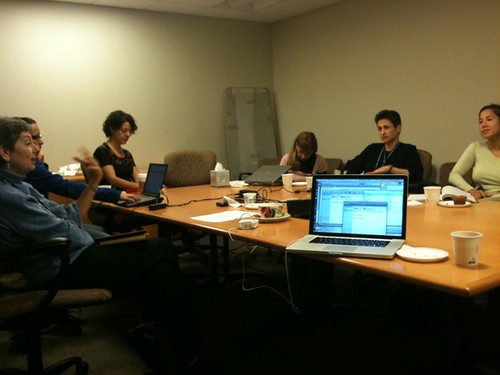
Present: Stan Shaw, Vivian Gainer, Margarita Sordo. Kat, Susanne Churchill, Ozlem, Zak, Guergana
The new DBP led by Stan Shaw addresses the epigenetics (DNA methylation, histone acetylation, histone methylation assayed using full genome-scale resequencing) of heart disease in the context of diabetes mellitus.
Kat reviewed the overall approach that we take in DBP's in defining cohorts through billing code,
Ozlem gave an update on the new de-identification pipeline.
We reviewed which fellow we might find to do some of the heavy lifting with Stan.
Kohane, Murphy, Weber, Churchill, Wilson. Mendis
Reviewed plugin architecture and convergence between web and Java client.
Reviewed "normals" project.
Mendis, Wilson, Savova, Weber, Kohane, Churchill,
Discussed the content for a hands on tutorial for the upcoming AMIA NOW.
Discussed what might be the priority areas for i2b2 in Core 2 for the competitive re competition.
The RFA has not yet be announced so the discussion was, of necessity, wide-ranging.
Shawn, Diane, Zak, Susanne, Griffin
Discussed provisioning new DBP's
Discussed the GO grants that other sites have obtained using i2b2 infrastructure.
Zak, Shawn, Griffin, Susanne
Committed to the details of AUG meeting at the CTSA
Reviewed additional hires required for ancillary i2b2
Discussed storage needs.
Murphy et al.
Reviewed data marts required for Core 1 activities
Present: Shawn, Griffin, Susanne, Diane, Zak, Mike
Discussed a bare-bones web client for PM management.
Discussed allocation of analyst time in light of present and possible funding streams
Discussed how to allocated new resources required for i2b2 collaborating grants (R01s and U01s).
Shawn Murphy led a discussion of the roadmap over the next year of i2b2.
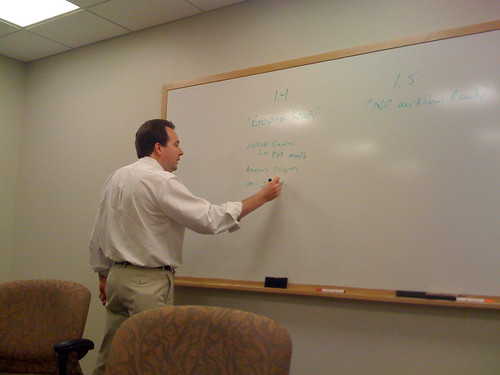
2b2 Roadmap for 2009-2010
Release 1.4 = “Enterprise Ready i2b2”
Release Candidate targeted for September 2009
This release allows the entire set of patients from the enterprise to be exposed to the research community of the hospital while preserving patient privacy, providing the way for basic queries to funnel down to a set of patients interesting to the investigator. The chosen set of patients is matched to controls from the enterprise database and a project-specific mini-database is created. Major software enhancements of release 1.4 compared to release 1.3 include a hardening of the project management cell with a new, full featured client for managing enterprise users, a plug-in architecture for the data repository cell that allows complex server-side workflows, and streamlined project mini-database creation with processes to build sets of matched control patients for a given set of patients of interest.
Release 1.5 = “NLP Workflow Enabled i2b2”
Release candidate targeted for February 2010
This release allows the text notes that are contained in a project-specific mini-database, such as clinic notes of a patient or radiology reports, to be processed in a high throughput manner with natural language processing (NLP). Any NLP tool can fit into this workflow, because the i2b2 workbench serves as a means to flow notes to the workstation of the NLP expert, and once the expert has transformed the text into coded data, re-import the coded data back into the i2b2 hive. The i2b2 workbench will also provide a tool for basic natural language processing to be performed using a Support Vector Machine for people who have no experience with NLP. Major software enhancements of release 1.5 compared to release 1.4 include a hardening of the data import process, a coupling of ontology management with data import processing, and a tool for non-expert NLP users.
Release 2.0 = “Open repository i2b2”
Release targeted for July 2010
This version represents the beginning of an open repository management of i2b2 software. An open Concurrent Versions System (CVS) will allow the i2b2 community to submit changes to the software that will be considered for all new releases.
Shared Health Research Information Network is the i2b2 framework to allow federated queries across multiple healthcare systems that is now being adopted by several national efforts, even while we continue to define it.
Richter, Murphy, Keogh, Kohane
Reviewed the very significant infrastructural requirements for i2b2 instances and the multiple data marts that we are deploying. Brent has two interesting solutions at HP and Sun that we are exploring.He will report back in one month with the results.
Murphy, McMurry, Kohane, Weber, McGow
Discussed some of the challenges of different namespaces for authentication across different i2b2 instances. All the more challenging with the proliferation of SHRINE implementations. Discussed different national solutions such as Shibboleth.
