December 12th, 2013
Three projects reviewed:
- Mortality and extra intestinal cancers in primary sclerosing cholangits (PSC) and inflammatory bowel disease.
- Vitamin D and C. Diff infections
- Thromboprophylaxis in IBD (post-hospitalization)
Professor Tianxi Cai ran a very interesting discussion about generating risk profiles for biomarkers and the problem in adjusting out the diseases that are along the causal pathway to mortality of those biomarkers. As a result of such an over adjustment, most biomarkers will give counter-conventional-wisdom associations.
Profs Cai and Shaw led a discussion of the the CAD NLP algorithm and demonstrated how the different priors and different ascertainment biases of different clinics could affect the accuracy of the NLP classification. Also discussed counter-intuitive coefficients in the model which may reflect confounding by the treatments for CAD.
r
Tianxi Cai led a discussion of how to discretize (or not) some of the parameters across our various disease populations regarding inflammatory burden. Also determination of whether we use the study population to establish the reference range or use the larger "official" reference ranges. Szolovits quoted the wonderful paper: The haze of Bayes, the aerial palaces of decision analysis, and the computerized Ouija board.

Professor Tianxi Cai led a discussion on the study designs to relate epigenetic endopathotypes and clinical outcomes.
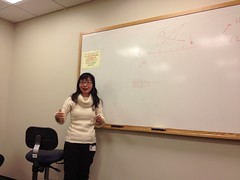





Guergana led a discussion of the user interface challenges of term selection (in an annotation of a clinical document task). She re-introduced the crew to the UMLS and Concept Unique Identifiers (CUIs). Understanding the dependencies, as Shawn Murphy pointed out is critical to providing users just the right set of terms to pick from (too many terms includes too many irrelevant terms and distracts/consumes the user and too few terms cripples expressivity). So we recognize that knowledge of the UMLS and the medical task is going to be required to optimally select the right set of CUI's to identify patients of interest. Sheng Yu demonstrated work in collaboration with Tianxi Cai that is quite striking in its ability to use the patient corpus to select (rank highly in a pick list) the CUI's of greatest relevance.
Zongqi et. al. reviewed current manuscript draft on the MS cohort and computational and clinical estimates of brain volume.
We also reviewed the agenda for the upcoming External Scientific Advisory Board meeting and retreat.

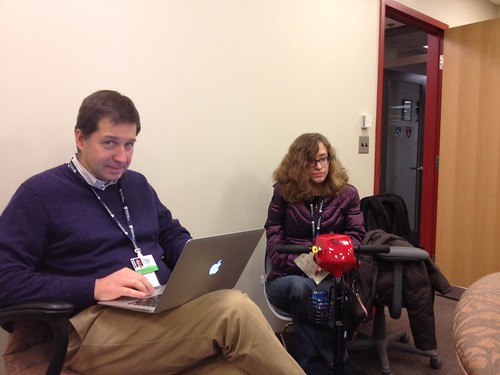

Kat Liao reviewed the interaction between LDL genetic risks and RA genetic risks in the determination of lipid profile.
Stan Shaw led the discussion on what studies we will initially perform to validate the cohort relative to other previously studied cohorts.
Shan Shaw led discussion of early validation exercises (e.g. mortality prediction from various clinical characteristics)
This led to a discussion of the wholesale representation of the NLP concept derivatives of a data mart within the i2b2 database. This includes a discussion, for example, whether we should store modifiers with concepts or new compound concepts (that bury the explicit modifiers). The most important part of the discussion was the remarkably small contribution that negation seems to have to the performance of the NLP algorithms.
Liao et al.
Several new faces introduced (see photo below) and Kat gave a quick update on Coronary Artery Disease phenotyping/
Ashwin discussed depression, anxiety in IBD (sample size ~5000). About 20% of the patients were depressed and various co-variates we assessed (for example TNF use was not significantly correlated to depression).
Zongqi presented the characteristics of the Multiple Sclerosis in the MS i2b2 Virtual Cohort.

A very nice result of i2b2, Vanderbilt and Northwestern teams with remarkable reproducibility (much better than I have seen for inter-expert variability in other studies) of the automated natural language processing-driven selection of patients with Rheumatoid Arthritis.
Shaw, Liao et al.
Non-fatal MI, cardiac revascularization procedures, CHF, all CVD death
Cai et al.
In the data mart 314,292 patients that may have DM
Training sets had more than 2 notes and test set was not thresholded in the same way. That explains why our first iteration of the algorithm was so unstable!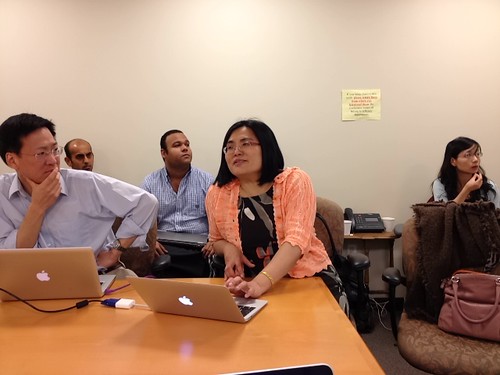
Zongqi Xia led a discussion of his projects regarding 1) EHR correlates of MS disease activity 2) Pre-symptomatic MS 3) Pharmacogenomics 4) MS comorbidities.
The discussion was the most extensive around how to evaluate the functional status.
Ashwin et al.,
Discussed policy and security details about joining an existing registry who have prospectively consented to an identified study with a data mart of IBD patients that contains those very same patients.
Reviewed NLP performance with ~800 gold-standard annotated (399 Crohn's and 378 Ulcerative Colitis) and 201 controls gold-standard annotated (each with approximately 8 years follow-up).
