J&J has made an interesting foray into creating a translational analytic platform using i2b2. This article from Bio-ITWorld summarizes an impressive bit of work led Eric Perakslis. They have pulled together multiple private and public data sources to help accelerate their discovery and validation process. Perhaps this presages a further push into trans-enterprise intelligence at the pharmaceutical companies?
Wednesday, January 20, 2010

Tuesday, December 29, 2009
The burden of obesity inferred through high precision rules
An interesting presentation by Ted Pedersen on finding obesity morbidities in i2b2 records.
Monday, December 14, 2009
German i2b2 implementations move forward
Thanks to Sebastian Mate for this update on the first German Academic i2b2-Workshop.
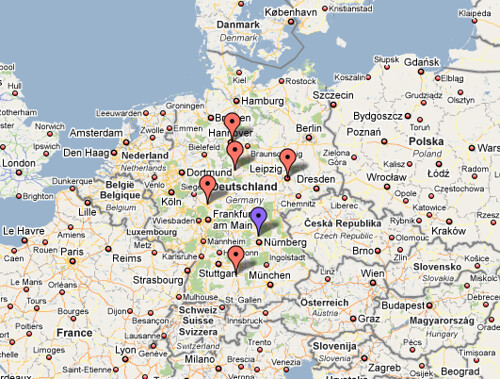
They had visitors from the universities of Goettingen, Ulm, Hannover, Giessen and Leipzig. Some of them had to travel hundreds of miles (see attached map) to visit them in Erlangen. Goettingen and Leipzig have i2b2 instances running, the others will try it out.
(1) Clinical Data Warehouse in Erlangen(2) i2b2 Overview, motivation and work in Erlangen(3) i2b2 in 30 Minutes - how the Erlangen Package works, with live-installation ;-)(4) The simple SQL-based Erlangen ETL approach - how we load data into the hive(5) i2b2 HIS-mapping - how we map hundreds of attributes from our HIS into the i2b2 instance (ONT and CRC)(6) TMF PID-Generator and i2b2(7) TMF Pseudonymization Service


Friday, December 11, 2009
RA
Discussed the SNP's on the genotyped data and how the continent of origin and the PHS labels of ethnicity are highly concordant.
Tuesday, November 17, 2009
Open Source
A very insightful response from Fred Trotter. He lays down the options in a very nuanced and clear fashion. Much appreciated.
Thursday, November 12, 2009
Major Depressive Disorder
Perlis, Smoller, et al.,
MInutes courtesy Patience Gallagher.
· Longitudinal Classifier
o Roy and Victor will finalize parameters of algorithm
o Victor will then report (and provide a visualization of):
§ % depressed, % well, # of all notes, etc
o To query Crimson: Victor will provide a list of medical record numbers within the two groups of interest (responsive and resistant) to Lynn Bry who can then report how many samples are currently available within Crimson
§ Parameters may need to be readjusted, depending on response from Crimson
· Discussion of Validation
o The issue with last week’s approach:
§ The algorithm is based on the text, so the first level of validation should not use information (i.e. clinician’s extensive knowledge of a patient) that is not in the text.
o New validation plan:
§ STEP ONE:
· GOAL: Determine if an expert clinician’s classification (based on notes only) is the same as the result of the algorithm
· Pull successfully classified notes
o All of a patient’s notes will be reviewed
o Clinicians will be blinded to the results of the classifier
o The sample of notes will reflect the results of the algorithm: “Random but representational”
o To keep the validation clean, it will be a “case-control” model - Treatment resistant vs. Responsive
o For now, only the electronic medical record will be used.
§ The consensus was that patient charts would be more annoying than beneficial, and the electronic records probably have sufficient information
§ Additionally, the information from the paper records is not integrated into the algorithm
§ May look at paper records down the road
§ STEP TWO: Compare list of patients that Roy knows are treatment resistant or responsive and run their notes through the classifier
· (Tianxi says this will be beneficial as it will give more power to the classifier)
§ STEP THREE: Use the Quick Inventory of Depression Severity (QIDS) as an external source of validation
· Many patients have QIDS scores in their charts – can determine if the algorithm classification is consistent with performance on the QIDS – this would be a cross-sectional measure
o The output of this approach would be: “Among patients classified s depressed, the mean QIDS score is ____”
§ NEXT STEPS:
· Do first level of the validation over the next few weeks.
o Victor will pass the notes to Roy.
o Roy will be the sole clinician reviewing the notes
· Manuscript:
o Victor and Tianxi have provided their input to Roy
o Roy will integrate this information and then re-distribute the manuscript to the group
· PV
o Update from Victor on obesity:
§ Compared the BMIs of this data set with all other patients and the distribution of the MDD sample is very similar, but right shifted compared to majority’s BMI distribution
· This makes sense! - Being depressed (and on antidepressants) leads to weight gain
Subscribe to:
Comments (Atom)